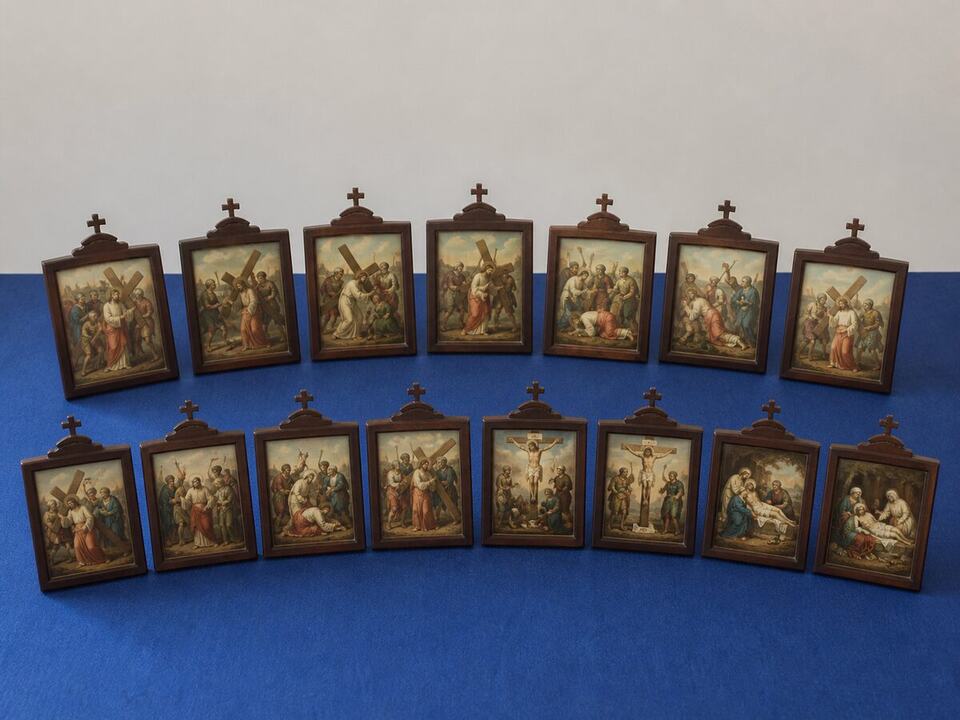
A field guide to choosing a sacred image for a Catholic home, setting its height and axis, and understanding how mount, frame and daylight age it.
A sacred image is chosen for a room by deciding first what the room is for, then letting the subject, size and place follow from that decision. It is hung so that its centre sits near eye level on an axis shared with the furniture below it, and it is framed with materials that will not fight the light it receives. The three decisions are connected: a print chosen for devotion can be undone by a frame that turns it into wallpaper, and a good frame cannot rescue an image hung as an afterthought.
The question assumes a real risk. Any framed picture, once it is on a wall, is also an object in a room, and the eye reads it as one. The way to keep devotion primary is to choose the subject before the wall, not after.
Look
Start with what is visible and repeatable. On this subject, that means naming the form, the joining points, the surface, the scale, and the condition before reaching for a historical label.
Know
The documented context comes next. Church documents, collection records, and conservation guidance answer different questions, so a confident sentence should make its source family clear.
Do not infer
A photograph or seller’s phrase cannot establish every material, edition, date, blessing, provenance, or devotional effect. Keep the open question visible and choose the next check.
Field register
How do you choose a sacred image for a room without turning it into decoration?Visible form, scale, parts, and surface.Context register
At what height and on what axis should a picture be hung?Use the source family that can actually answer the question.Boundary register
What the evidence can and cannot settleStop where the object record stops.How do you choose a sacred image for a room without turning it into decoration?
A sacred image is chosen for a room by deciding first what the room is for, then letting the subject, size and place follow from that decision. It is hung so that its centre sits near eye level on an axis shared with the furniture below it, and it is framed with materials that will not fight the light it receives. The three decisions are connected: a print chosen for devotion can be undone by a frame that turns it into wallpaper, and a good frame cannot rescue an image hung as an afterthought. The most useful description is concrete enough for another reader to check.
At what height and on what axis should a picture be hung?
The question assumes a real risk. Any framed picture, once it is on a wall, is also an object in a room, and the eye reads it as one. The way to keep devotion primary is to choose the subject before the wall, not after. When sources disagree or the record is incomplete, the uncertainty belongs in the sentence.
Care stop
What the evidence can and cannot settle
Stop before cleaning, polishing, washing, forcing, opening, or authenticating an object when its condition is fragile, its provenance matters, or the question belongs to a priest, publisher, seller, conservator, or other competent authority.