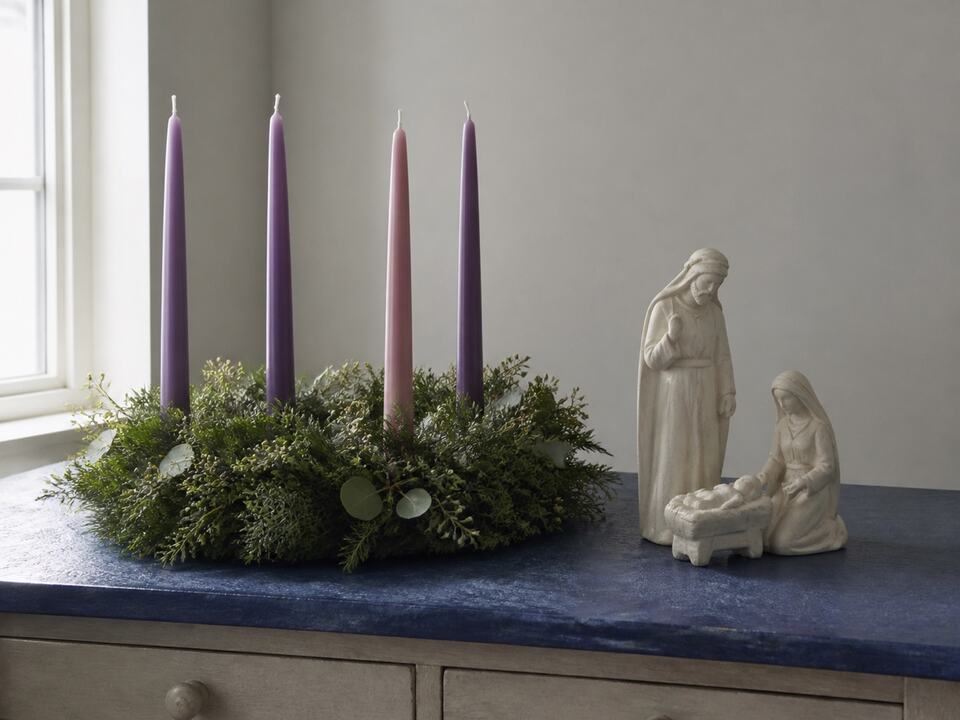
An Advent wreath and a nativity scene can share a household season without becoming the same object or the same ritual.
The Advent wreath marks a seasonal rhythm, while a nativity scene represents a different household object and image tradition. They can share a room without being collapsed into one generic decoration.
Plan the placement around flame safety, children, pets, heat, moisture, and storage. A seasonal object is easier to keep when its materials and small parts are recorded before the box is closed.
Look
Start with what is visible and repeatable. On this subject, that means naming the form, the joining points, the surface, the scale, and the condition before reaching for a historical label.
Know
The documented context comes next. Church documents, collection records, and conservation guidance answer different questions, so a confident sentence should make its source family clear.
Do not infer
A photograph or seller’s phrase cannot establish every material, edition, date, blessing, provenance, or devotional effect. Keep the open question visible and choose the next check.
Field register
Separate the two customsVisible form, scale, parts, and surface.Context register
Plan a safe displayUse the source family that can actually answer the question.Boundary register
Store the season wellStop where the object record stops.Separate the two customs
The Advent wreath marks a seasonal rhythm, while a nativity scene represents a different household object and image tradition. They can share a room without being collapsed into one generic decoration. The most useful description is concrete enough for another reader to check.
Plan a safe display
Plan the placement around flame safety, children, pets, heat, moisture, and storage. A seasonal object is easier to keep when its materials and small parts are recorded before the box is closed. When sources disagree or the record is incomplete, the uncertainty belongs in the sentence.
Care stop
Store the season well
Stop before cleaning, polishing, washing, forcing, opening, or authenticating an object when its condition is fragile, its provenance matters, or the question belongs to a priest, publisher, seller, conservator, or other competent authority.