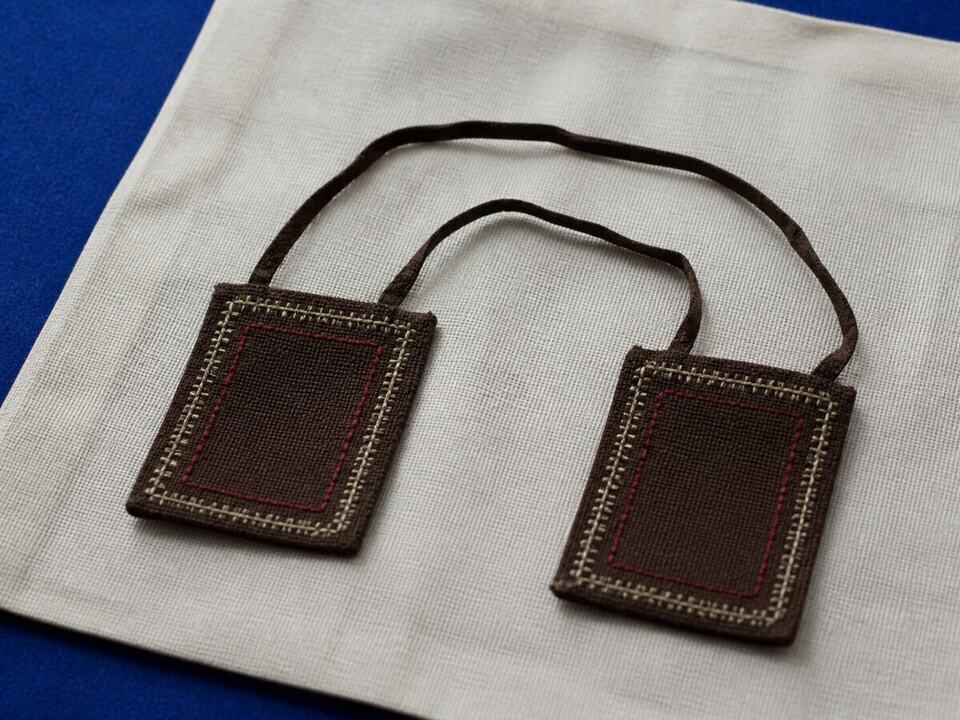
How to read a yarn label, how knitting and crochet differ in small pieces, and how to handle and store a fragile scapular or cord with a light touch.
A small textile object is read the way any textile is read: from the label first, then from the fabric itself. The label gives fibre, weight, yardage, gauge and the recommended wash, and those five facts decide whether the piece will hold its shape or drift. For a fragile devotional object such as a scapular or a cord, the same reading applies, with one addition: the handling and storage matter as much as the fibre, because a small piece has little material to absorb wear.
Before choosing a fibre, read the label in a fixed order. Fibre content comes first, because it predicts how the object will behave: animal fibres such as wool felt and hold memory, plant fibres such as cotton stay cool and lose shape under weight, and synthetic fibres resist moths but can pill. Weight comes second, and it is not the same as thickness. A lace or fingering weight is measured in tens of grams per ball and produces a fine, flat fabric; a worsted or bulky weight produces a thick fabric from the same number of stitches. Yardage comes third, and it is the number that actually tells you whether one ball is enough for a small piece. Gauge comes fourth: the label prints a stitch and row count over a stated area, usually 10 cm or 4 inches, and that count is the only reliable bridge between a pattern and your hands. The wash instruction comes last and is the one most often ignored. A label that says hand wash cool and dry flat is telling you the fibre will felt, stretch or shrink in a machine, and no later care will undo that.
Look
Start with what is visible and repeatable. On this subject, that means naming the form, the joining points, the surface, the scale, and the condition before reaching for a historical label.
Know
The documented context comes next. Church documents, collection records, and conservation guidance answer different questions, so a confident sentence should make its source family clear.
Do not infer
A photograph or seller’s phrase cannot establish every material, edition, date, blessing, provenance, or devotional effect. Keep the open question visible and choose the next check.
Field register
Start with the fibre and its weightVisible form, scale, parts, and surface.Context register
How do you read a yarn label before choosing a fibre?Use the source family that can actually answer the question.Boundary register
Where the evidence stopsStop where the object record stops.Start with the fibre and its weight
A small textile object is read the way any textile is read: from the label first, then from the fabric itself. The label gives fibre, weight, yardage, gauge and the recommended wash, and those five facts decide whether the piece will hold its shape or drift. For a fragile devotional object such as a scapular or a cord, the same reading applies, with one addition: the handling and storage matter as much as the fibre, because a small piece has little material to absorb wear. The most useful description is concrete enough for another reader to check.
How do you read a yarn label before choosing a fibre?
Before choosing a fibre, read the label in a fixed order. Fibre content comes first, because it predicts how the object will behave: animal fibres such as wool felt and hold memory, plant fibres such as cotton stay cool and lose shape under weight, and synthetic fibres resist moths but can pill. Weight comes second, and it is not the same as thickness. A lace or fingering weight is measured in tens of grams per ball and produces a fine, flat fabric; a worsted or bulky weight produces a thick fabric from the same number of stitches. Yardage comes third, and it is the number that actually tells you whether one ball is enough for a small piece. Gauge comes fourth: the label prints a stitch and row count over a stated area, usually 10 cm or 4 inches, and that count is the only reliable bridge between a pattern and your hands. The wash instruction comes last and is the one most often ignored. A label that says hand wash cool and dry flat is telling you the fibre will felt, stretch or shrink in a machine, and no later care will undo that. When sources disagree or the record is incomplete, the uncertainty belongs in the sentence.
Care stop
Where the evidence stops
Stop before cleaning, polishing, washing, forcing, opening, or authenticating an object when its condition is fragile, its provenance matters, or the question belongs to a priest, publisher, seller, conservator, or other competent authority.